
Among the 30-share Sensex blue-chip pack, Bharti Airtel, ITC, Kotak Mahindra Bank, Hindustan Unilever, Titan, UltraTech Cement, HCL Technologies, and Power Grid, were the biggest gainers. Tata Steel, IndusInd Bank, JSW Steel and Bajaj Finserv were the laggards.

Operating margins have been the primary driver of corporate earnings in India in recent quarters, despite revenue growth suffering from weak consumer demand. Companies across sectors have reported a sharp improvement in earnings before interest, tax, depreciation, and amortisation (Ebitda) margins over the past two years, benefiting from lower commodity and energy prices. Higher margins more than compensated for slower revenue growth, resulting in double-digit growth in net profit for five consecutive quarters.

Factory production expanded by 1.3 per cent on an annual basis in January on account of better performance by mining and manufacturing sectors, though capital goods segment remained in contraction mode, as per government data released on Friday. The Index of Industrial Production (IIP) had contracted by 0.6 per cent in January 2021. The growth was 0.7 per cent in December 2021. As per the data released by the Ministry of Statistics and Programme Implementation, the growth in the mining sector was 2.8 per cent against a contraction of 2.4 per cent in January 2021.

Chief economist at State Bank of India has revised downward the full-year growth forecast to a low 6.8 per cent from 7.5 per cent earlier for FY2023, citing "the way below GDP numbers for the first quarter". The National Statistical Office on Wednesday released the Q1 growth numbers which showed a consensus growth of 13.5 per cent, pulled down by the poor show of the manufacturing sector, which reported a paltry 4.8 per cent expansion in the first three months of FY23, negating the robust show by the services sector. Consensus forecast was 15-16.7 per cent of which the RBI made the highest forecast of 16.7 per cent.
Factory production expanded by 1.7 per cent on an annual basis in February on account of improved performance by the mining and power generation sectors, as per government data released on Tuesday. The Index of Industrial Production (IIP) had contracted by 3.2 per cent in February 2021. The growth was 1.5 per cent in January 2022. As per the data released by the Ministry of Statistics and Programme Implementation, the growth in the mining sector was 4.5 per cent against a contraction of 4.4 per cent in February 2021.

India's industrial production growth remained subdued for the second straight month and expanded by 3.2 per cent in October, mainly due to the waning low base effect while mining, power and manufacturing sectors performed well. The manufacturing sector, which constitutes 77.63 per cent of the Index of Industrial Production (IIP), grew two per cent in October, according to data released by the National Statistical Office (NSO) on Friday. The mining sector output rose 11.4 per cent in October, while power generation increased 3.1 per cent.

'With the deployment of a higher degree of mechanisation, awarding contractual mining to MDOs and operational efficiency, we feel confident of achieving the desired target.'

India's economic growth slowed down to 4.4 per cent in the third quarter of 2022-23 mainly due to poor performance of the manufacturing sector. In October-December 2021, the economy grew by 11.2 per cent and by 6.3 per cent in the July-September 2022 quarter, according to data released by the National Statistical Office (NSO) on Tuesday.

Private consumption is back driven by festive spending, and the medium-term economic outlook remains bullish as the innate strength of the macro-fundamentals reasserts itself, the Reserve Bank Bulletin said on Wednesday. Global economic activity remained resilient during Q4:2024 amidst fragile confidence and rising protectionism, said an article on 'State of the Economy' published in the November Bulletin.

The country's economic growth hit a decade low of 5 per cent in the last fiscal on account of poor performance in the farm, manufacturing and mining sectors.

The Reserve Bank on Monday pitched for creation of a conducive environment for investment and faster clearances of projects to boost economic growth which slowed to a decade low of 5 per cent in the previous fiscal.

India's economy grew by 6.3 per cent in the second quarter of the current fiscal, official data released on Wednesday showed.

The earnings of India Inc hit a record high in the 2022-23 (FY23) January-March quarter (fourth quarter, or Q4), compared with their poor showing in the previous two quarters of the financial year. The rise in earnings, however, is exclusively led by banking, financial services, and insurance (BFSI) companies. A better-than-expected showing by banks and non-bank lenders in Q4FY23 more than compensated for the earnings contraction in the non-BFSI space.

Capital goods output registered a steep decline of 16.5 per cent in June

From the Sensex basket, Tata Motors, State Bank of India, Tata Steel, Power Grid, NTPC, Bajaj Finserv, Bajaj Finance and Asian Paints were the major laggards.

Industrial production grew 11.9 per cent in August mainly due to a low-base effect and good performance by manufacturing, mining and power sectors that surpassed the pre-COVID level. The manufacturing sector, which constitutes 77.63 per cent of the Index of Industrial Production (IIP), grew 9.7 per cent in August, according to the data released by the National Statistical Office (NSO) on Tuesday. The mining sector output rose 23.6 per cent in August, while power generation increased 16 per cent.

Beside manufacturing, deceleration was also witnessed in sectors like agriculture, construction and electricity, gas and water supply.

Growth of capital goods at 9.6 per cent is inspiring as the investment cycle is expected to rebound in the coming months.

The Centre may overshoot the Rs 56,260 crore target for dividend receipts from central public-sector enterprises (CPSEs) set for FY25 and is likely to end up getting around Rs 65,000 crore this financial year, according to a senior government official. This excludes dividend from nationalised banks and financial institutions. As on October 21, the Centre collected Rs 28,913 crore as dividend and other investment from CPSEs, accounting for over 50 per cent of the Budget Estimate for FY25.
India Inc has reported a muted start to the financial year 2024-25, with a decline in net earnings and a modest single-digit uptick in revenues. An analysis of 488 companies that have released their results for the June 2024 quarter reveals a 1.6 per cent year-on-year (Y-o-Y) drop in combined net profit -- the weakest performance in the past seven quarters. In stark contrast, the combined net profit of these companies experienced a 13.6 per cent Y-o-Y increase in the previous quarter (Q4FY24) and a 65.2 per cent Y-o-Y rise in Q1FY24.

The economic growth slowed to a decade low of 5 per cent in the 2012-13 fiscal.

In a significant move to enhance its strategic resource security, India has officially released its first-ever critical minerals list, identifying 30 key critical minerals crucial to the nation's economic growth and technological development. This pioneering step aims at reducing import dependence, enhancing supply-chain resilience, and supporting the country's net-zero objectives. Union Minister Parliamentary Affairs, Coal and Mines Pralhad Joshi, while releasing the Critical Minerals for India report in New Delhi on Wednesday, said, "India is readying for an Atmanirbhar Bharat."

What came to the rescue of the IIP numbers in February were mining and electricity.
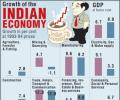
Overcoming a negative growth in mining sector and a meagre 2 per cent growth in agriculture, the economy continued on its upward trajectory, which was witnessed during the first quarter of the current financial year.

India's industrial production growth slowed to 3.8 per cent in January, while the February retail inflation at 5.09 per cent remained within the Reserve Bank's comfort zone for the sixth straight month, according to the latest government data. Growth in factory output, based on the Index of Industrial Production (IIP), slowed to 3.8 per cent in January 2024, mainly due to poor performance of manufacturing, mining and power sectors, according to the data released by the Ministry of Statistics & Programme Implementation.

'... that it once again shies away from renewing its commitment to strategic divestment,' points out A K Bhattacharya.

India's industrial output grew a better-than-expected 6.4 per cent in August compared with a downwardly revised 4.1 per cent growth a month ago.

The manufacturing sector, a key indicator of economic activity, grew 10.6 per cent year-on-year in October.

Government-owned Life Insurance Corporation of India (LIC) has seen substantial gains from its investments in Adani group shares, which have experienced a significant recovery over the past year. The value of LIC's stake in Adani group companies surged by 51.6 per cent, or Rs 22,591 crore, reaching Rs 66,388 crore as of Friday's close. This compares to Rs 43,797 crore on May 31 last year, according to stock exchange data.

The International Monetary Fund, in its latest World Economic Outlook, projected an average growth rate of about 3.8 percent in market prices for India in fiscal 2013, which is expected to pick up to 5.1 per cent next year.

Bad loans, however, continued to rise in the micro, small and medium enterprises category

Days before Diwali, the monthly economic review by the finance ministry has highlighted moderation in urban demand, softening consumer sentiments and limited footfall as areas that need to be watched. In its review, released on Monday, the ministry also noted the early signs of artificial intelligence displacing workers, as described in anecdotal reports. The commentary from several large consumer goods companies, including Nestl India, Hindustan Unilever, and ITC, in their recent quarterly earnings, has been around a sluggish urban demand. Rural consumption, however, has mostly seen a revival, the companies pointed out.
Industrial production grows at 2.1 per cent in March.

India's corporate sector is likely to report a slowdown in revenue growth and earnings for the July-September 2023 period (Q2FY24), according to earnings estimates by brokerages, after the country's top listed companies posted higher than expected profits for the first quarter. The combined net profit of Nifty50 companies, based on brokerage estimates, is expected to have grown by 19.6 per cent year-on-year (Y-o-Y) to Rs 1.75 trillion in Q2FY24 - a sharp deceleration from 37.6 per cent Y-o-Y growth in the combined earnings of index companies in the April-June 2023 period. According to estimates, the combined earnings in the second quarter would be down 8.8 per cent on a quarter-on-quarter (Q-o-Q) basis and the lowest in the past three quarters.

In twin blows to Indian economic revival, higher food prices drove retail inflation to a five-month high of 7.4 per cent while factory output fell for the first time in 18 months. The second consecutive month of rise in consumer price index (CPI)-based inflation will add to the pressure on the Reserve Bank of India (RBI) to again raise interest rates to tame high prices. Inflation has been above the targeted zone for the ninth month in a row and as per statute, the RBI will now have to explain to the government in writing why it failed to keep prices below 6 per cent.

India's economy grew 7.6 per cent in the September quarter of this fiscal and remained the fastest-growing large economy, mainly due to better performance by manufacturing, mining and services sectors, the government data showed on Thursday. The gross domestic product (GDP) expanded by 6.2 per cent in the July-September quarter of 2022-23. India remained the fastest-growing major economy, as China posted a 4.9 per cent growth in July-September 2023.

Industrial production growth entered positive territory after a gap of two months with a record 22.4 per cent rise in March this year, mainly due to the low-base effect and good show by manufacturing, mining and power sectors. The manufacturing sector -- which constitutes 77.63 per cent of the index of industrial production (IIP) -- grew by 25.8 per cent in March 2021, as per the data released by the National Statistical Office (NSO) on Wednesday. The mining sector output too grew 6.1 per cent in March, while power generation increased by 22.5 per cent.

MNC funds invest in companies where foreign promoters have more than 50 per cent shareholding.

'This was earlier driven by industries and the commercial sector.'

The growth in the contact-intensive portion of the economy trailed our expectation, highlighting how imperative it is for confidence to improve, either through accelerated vaccinations or otherwise, to drive a sustainable recovery in these sectors, asserts Aditi Nayar.
